
Designers
We bring different perspectives to the table, but we’re united by a love for purposeful work, thoughtful design, and real connection.
Julie Wong
Julie Wong (黄福慈) is an artist, activist, and educator in her full-blown konenki phase (second spring). She works with reclaimed textiles and salvaged materials to create colorful, large-scale works and installations gleefully disrupting the male gaze and empowering women.
From quilts and wearable art incorporating boro and sashiko techniques to crocheted mandala canopies in colors from the Psychedelic Sixties, she draws upon crafts from many cultures traditionally considered to be “women’s work,” often born of necessity and used for practical purposes but also celebrating the universal human urge to create and share our own unique experiences.
Wong believes that everyone is an artist and that art is the vital, living red thread that draws us together, records our histories, expresses our dreams, and communicates our understanding of the world. She sees every action as having the potential to be a work of art and every human being as a potential artist. Wong’s work is colorful, chaotic, collaborative, and joyful!
Lead Artist: Julie Wong, Website: https://www.juliewongart.com, IG @juliewong.art
Artist Statement
“THE UNITED STATES OF EMERGENCIES” COLLECTION
Drawing on a wide range of traditional crafts often considered to be “women’s work,” artist, activist, and educator, Julie Wong 黄福慈, uses salvaged materials to create colorful, large-scale works and installations disrupting the male gaze and empowering women.
In collaboration with fellow artists and mentors: Sequoyah Tiger Moon, Vincent Destavia, Katiria Murguia, and Bakari Santos, Wong created “We, The Peoples,” four 12-foot tall Native American, Latin@, African, and Asian goddesses. These goddesses are rooted in our cultures and communities — cultures and communities which existed before the organization of the United States and which play vital roles in the past, present, and future of our country. Our thanks to Scott Morse for his support in preparing for the Fashion v. Fascism event.
On the 250th anniversary of the signing of the Declaration of Independence, we find democracy in crisis. The 2026 collection entitled, “The United States of Emergencies” is a response to the politics of fear and hate which have taken hold in our country with an alarming level of brazenness — a time when our mere presence is seen as an existential threat and labeled as cause for a “state of emergency.”
Look 1: STOLEN LANDS, STOLEN SISTERS
At today’s event, we are joined by Manny Lieras and Native Boogie and the Beats — sharing the power and beauty of powwow culture with the next generation — and invite you to join us in taking action by remitting the Shuumi Land Tax to the Sogorea Te’ Land Trust which seeks to rematriate the land, restoring the Liskas Ohlone people to their rightful place in sacred relationship with their ancestral lands on which the Oakland Rotunda now stands (https://sogoreate-landtrust.org).
Look 2: NOT YOUR MODEL MINORITY
We remember Frank H. Ogawa, the civil rights leader for whom Oakland civic center plaza is named and who served as Oakland’s first Japanese American city council leader for nearly three decades. As a child, Ogawa was labeled an enemy of the State and forced to relocate with his family to the Topaz, Utah concentration camp during WWII. During COVID, when anti-Asian American Pacific Islander (AAPI) violence surged, Jacob Acevedo, Katrina Ramos, Jessica Owyoung, Derek Ko, and Darren Lee responded by founding Compassion in Oakland with the goal of empowering the AAPI community of Oakland with resources that promote safety, unity, and education/awareness and offering chaperone services to targeted communities who feel unsafe. (https://compassioninoakland.org).
Look 3: UNITED STATES OF EMERGENCIES
We hold in our hearts the 4,790 people detained by ICE in the SF Bay Area in 2026, a nearly 70% increase vs. year ago and invite you to support the efforts of the East Bay Spanish Speaking Citizens’ Foundation, which serves the needs of low-income Latino families and individuals in Oakland improve their lives, preserve their culture, and develop as community leaders by providing support for families impacted by ICE and through educational enrichment services and promoting civic engagement (https://www.sscf.org/about).
Look 4: “I CAN’T BREATHE”
On this day when we rise up against the politics of fear and hate, we also remember, LoEshe Adama Lacy, who inspired the City of Oakland’s motto: Oakland Love Life and whose father founded the Love Life Foundation in her memory to provide a supportive and empowering environment for at-risk youth and mobilize community support to change economic and social conditions that lead to violence (https://www.lovelifefoundation.org). We are also grateful to Kev Choice who wrote Oakland’s beautifully worded Love Life acknowledgement.
Lee Rickie is an Oakland based fashion designer, creative director, and founder of LEERICKIE, an independent menswear and unisex label known for its distinctive approach to modern dressing. With a focus on limited production, thoughtful design, and carefully sourced textiles, Rickie has built a body of work that reflects individuality, craftsmanship, and a strong point of view.
His designs have been featured in Vogue, Vanity Fair, People, Harper’s Bazaar, and GQ South Africa, and have been worn by artists and public figures including Mary J. Blige, Common, Teddy Swims, and Morris Chestnut. Beyond his work as a designer, Rickie has taught fashion and creative enrichment since 2011, using design as a way to encourage self-expression and introduce the next generation to the possibilities of the fashion industry.
Based in Oakland, Rickie continues to design and produce through LEERICKIE while using fashion as a platform for storytelling, culture, and creative expression.
Website: leerickie.com
Artist Statement
Freedom, Resistance & Collective Liberation
This presentation explores the journey from awareness to resistance and ultimately to collective liberation through three distinct looks.
Look 1: The Awakening
The first look, The Awakening, represents the history and truth we carry with us.
Look 2: The Protector
The second look, The Protector, shifts from awareness to action, exploring the idea of community, protection, and care as forms of resistance.
Look 3: Liberation
The final look, Liberation, represents freedom and possibility, with the silhouette expanding outward as a visual expression of release and movement toward the future.
Together, the three looks tell one story: We carry our history. We carry each other. Together, we carry the future.
Lee Rickie
My name is Tianna Charity, owner of REALTIME Fashion. I love God. I am a mother, a teacher, and an Army veteran with a deep curiosity about life. My artistry is inspired by my awe of God, the beauty and pain of humanity, and the range of experiences that shape our existence.
REALTIME is a faith-based wearable art brand rooted in the moments that mark personal growth. Fashion has always been more than clothing to me. It is multifaceted: art, refuge, expression, worship, but also a tool for resistance, communication, and confrontation.
Artist Statement
For my Fashion V. Fascism collection, The Other/The Enemy, I began with the foundation of my belief: that human worth is inherent. It is not determined by wealth, productivity, usefulness, status, or the amount of information that can be extracted from us. This foundation led me to question what happens when power treats human worth as conditional. Through concentrated wealth, technological surveillance, and environmental injustice, The Other/The Enemy examines three ways human beings can be reduced: to profit, data, and sacrifice. Through artistic and architectural design, I give those systems physical form, exposing the tension between what they make of us and the worth they can never take from us.
REALTIME Fashion Collection The Other/The Enemy
LOOK 1: UNTOUCHABLE
UNTOUCHABLE examines concentrated wealth and the power it creates to exist beyond consequence. I considered the point where wealth becomes appetite... An endless pursuit of money, influence, and control, even when that accumulation comes at the expense of others. The look represents a system where human beings can become secondary to profit, while those who benefit most remain protected from the consequences.
LOOK 2: HUMAN, NOT DATA
HUMAN, NOT DATA examines the tension between human identity and technological surveillance. Facial recognition and artificial intelligence attempts to identify, categorize, track, and interpret a person without ever knowing who that person is. The look questions what is lost when identity becomes information... When our faces, movements, behaviors, and bodies can be translated into data that is collected and used beyond our control.
LOOK 3: SACRIFICE ZONES
SACRIFICE ZONES confronts environmental injustice and the unequal human cost of extraction, pollution, and industry. The communities that live closest to environmental hazards are often asked to bear consequences that extend far beyond the benefits they receive. The look examines the idea of the “sacrifice zones,” a place, and ultimately a population, treated as acceptable collateral for economic growth and convenience.
REALTIME Fashion
Erica Ledward-Furlong is a Bay Area fashion designer, educator, and creative activist whose work lives at the intersection of fashion, history, and community transformation. With more than 20 years of experience teaching sewing and design, Erica believes creativity can become a powerful language for identity, resistance, and change.
She is the founder of EVarize Designs and the creator of Sew What, a culturally responsive fashion and arts program that has introduced generations of girls to sewing, storytelling, and activism. She also serves as Executive Director of the BayGanda Foundation, which supports educational opportunities for girls in the Bay Area and Uganda.
Erica creates spaces where young people—particularly girls of color—can see themselves, tell their stories, and understand the power of their creative voices. Her work is grounded in the belief that fashion is more than adornment: it can preserve memory, confront injustice, and help us imagine freedom.
Artist Statement
This collection travels from the Mythic Past of the Antebellum South toward the truths of extraction, resistance, and reclamation.
Look 1: The Myth
The romanticized image of the Southern belle—constructed from African sugar bags—with her sculpted bodice, sweeping skirt, and carefully constructed beauty—often conceals the system that made such luxury possible.
Beneath that beauty was an economy built through chattel slavery and the forced labor that fueled the cotton, sugar, and other industries of the American South. By 1860, the slaveholding South had become one of the wealthiest economies in the world—not simply because of the commodities it produced, but because Black people themselves were treated as commodities. The dress asks us to remember who created the wealth, who paid its human cost, and who continued to make beauty in the face of brutality.
Look 2: The Tree of Life
The second look holds several truths: the tree as a symbol of ancestry, strength, life, and connection; the magnolia trees from which Black bodies were hung; and coffee as a reminder of another global industry shaped by exploited labor and woven into our culture and everyday rituals. Cotton, rope, coffee, and suspended rings transform the garment into beauty, memorial, and witness.
In the third and final looks, the sugar bags are turned inside out, reimagined, and repurposed. Concealing their commercial labels; exposing the unfinished sack is both a construction choice and a metaphor. The material is separated from its original purpose and transformed through Black creativity. This reversal turns history inside out, revealing what has been hidden and reclaiming materials connected to labor, commerce, and extraction.
Looks 3 and 4: The Message of Resistance and Revolution
These two looks bring the story into the present. Featuring original artwork hand-painted by Bay Area artist @Brutus, they reflect the noise surrounding us, the injustice happening and the chaos unfolding in our streets. Yet within that noise is a reminder that we are not powerless. Art can expose the myth, reclaim the narrative, and help us imagine something beyond what we have inherited.
The final look is revolution: an extraction from a myth that never truly existed. The revolution may not be televised, but it will be created, worn, spoken, painted, and lived. We will resist. We will stand together. And we will use art to fight for our collective freedom.
Evarize
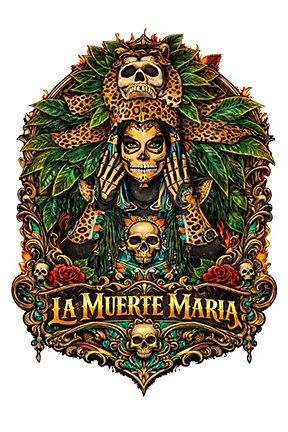
Maria Flores Scott
La Muerte Maria
Maria Flores Scott, known artistically as La Muerte Maria, is a Mexican-American cultural artist, designer, performer, and retired educator born and raised in East Los Angeles and Boyle Heights.
After 37 years in education, Maria retired to devote herself more fully to her art. Her work transforms fashion into storytelling through hand-created and airbrushed garments, sculptural headpieces, cultural symbolism, and performance. Deeply rooted in her Mexican-American heritage and Chicano community, her creations range from elaborate Día de los Muertos and Catrina works to bold pieces of wearable protest art.
Maria uses the human body as a moving canvas, addressing subjects including freedom, democracy, education, immigration, social injustice, and political power. Her work has been presented through cultural celebrations, museums, parades, festivals, performances, and music productions throughout California and beyond.
As La Muerte Maria, she creates work that celebrates her culture while also challenging audiences to look closer, question what they see, and engage in conversation. For Maria, art is not only something to be seen—it is a voice, and she intends to use hers.
Artist Statement
For Fashion vs. Fascism Oakland, I present three wearable protest pieces—Lady Liberty, The Burning Constitution, and The Shitshow Circus featuring Kristi Noem—using fashion, symbolism, and satire to confront what I see happening in America today.
Look 1: Lady Liberty
Lady Liberty challenges the promise of American freedom. Draped in a distressed American flag and surrounded by imagery of protest, resistance, political power, and a divided nation, Liberty stands bound in chains. Her torch remains raised, but she is not free—a reflection of the growing distance between the freedoms America promises and the reality many people experience.
Look 2: The Burning Constitution
The Burning Constitution centers on the words “We the People,” surrounded by flames and imagery representing racism, white supremacy and the KKK, billionaires, corporations, and concentrated wealth and power. The piece asks who truly holds power in America and warns what can happen when hatred, money, and private interests become more powerful than the rights and voices of ordinary people.
Look 3: The Shitshow Circus
The Shitshow Circus combines one of my earlier political works with a new piece featuring Kristi Noem. Through caricature, exaggeration, and dark humor, I portray a political climate that has become a spectacle—where actions affecting real human lives can be turned into entertainment, distraction, and performance.
These pieces are unapologetically political because the issues behind them affect real lives.
As a Mexican-American woman raised in East Los Angeles and Boyle Heights, and after spending 37 years as an educator, I have learned that our voices matter. Art is one of the ways I choose to use mine.
I don’t expect everyone who sees my work to agree with me. I do expect it to make people look. I want them to think. I want them to question. I want them to talk.
For me, that is the power of protest art.
The dress is my canvas.
The body gives it movement.
The message gives it purpose.
And I refuse to be silent.
— Maria Flores Scott / La Muerte Maria